
Make an energy plan now
Don’t get caught without a plan.
Understand energy markets and how they impact your business.
Make markets work for you.
Get access
Power reliability constraints owing to expectations of increased power demand has practically become dinner table conversation around the United States. We’ve been in the energy business for almost 3 decades. Energy is a hot topic both in business and in day-to-day conversation. What do the data show? And, as a result, how concerned about reliability should businesses be these days?
Data Centers and Load Growth Forecasts
US Department of Energy (DOE)
So, what do the data show? In July, 2025 the Department of Energy (DOE) issued a report detailing significant increased risk of reliability disruptions and blackouts. The cause, according to the report, is data center-driven load growth, the pace of base load retirements and the lag in adding new base load due to long and challenging utility interconnection procedures. While the report is somewhat controversial as it significantly discounts the reliability benefits of adding new renewable resources and backup power, it does point to a seemingly common cause for concern, data center load growth.
US Energy Information Agency Information (EIA)
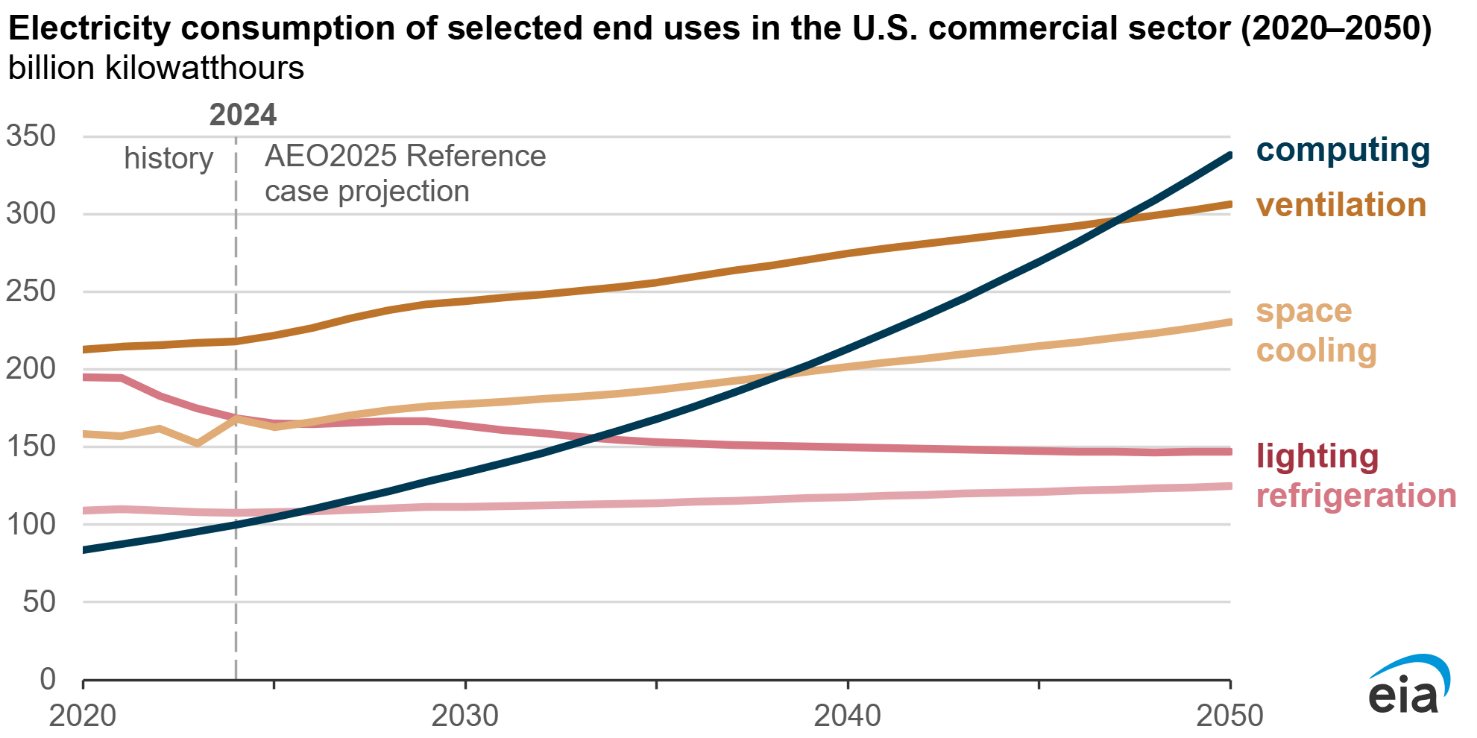
Organizations across the US and the globe have attempted to forecast data center load growth, including the EIA. Their forecast, which was published in April 2025, expects significant growth in commercial computing demand over the next 25 years. Like many other forecasts, the EIA underscores the conventional wisdom about projected demand growth. The report found that:
In [the Annual Energy Outlook’s Reference case, [the EIA] project[s] the electricity consumed for commercial computing will increase faster than any other end use in buildings. Computing accounted for an estimated 8% of commercial sector electricity consumption in 2024 and grows to 20% by 2050. Ultimately, more electricity could be consumed by computing than for any other end use in the commercial sector, including lighting, space cooling, and ventilation (https://www.eia.gov/outlooks/steo/pdf/steo_full.pdf).
Global Load Forecast: The International Energy Agency (IEA)
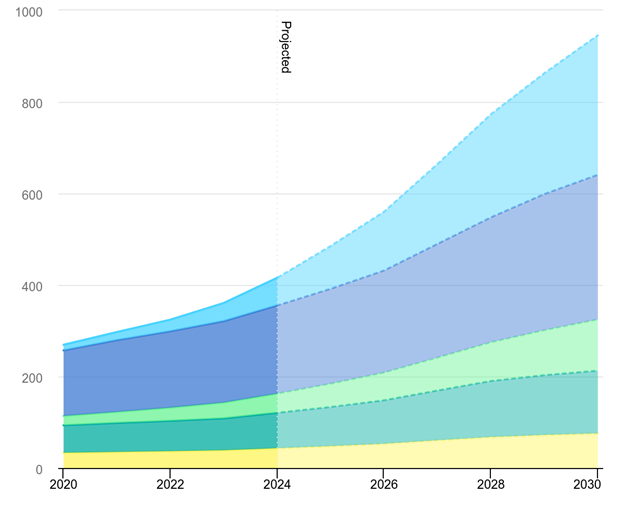
Meanwhile, the International Energy Agency provides a global perspective on demand growth projections (IEA (2025), Energy and AI, IEA, Paris https://www.iea.org/reports/energy-and-ai, Licence: CC BY 4.0). Their analysis, published this year, offers a range of scenarios that indicate that while data center-driven load growth is expected to increase significantly, uncertainty remains as to the pace and scale of AI-driven load growth.
According to the IEA, data centers can be designed and built more quickly than utility-scale supply resources can be brought online, thus causing resource constraints. This mismatch in planning and execution presents challenges for the energy and utility industries. Of note, the EIA explains that “electricity consumption from data centres…has grown at 12% per year over the last five years” at a global level.
In addition, IEA explains that “[t]hree sensitivity cases (Lift-Off, High Efficiency and Headwinds) capture uncertainties in efficiency improvements in hardware and software, AI uptake and energy sector bottlenecks. Here’s what the IEA has to say.
Our Base Case finds that global electricity consumption for data centres is projected to double to reach around 945 TWh by 2030 in the Base Case, representing just under 3% of total global electricity consumption in 2030. From 2024 to 2030, data centre electricity consumption grows by around 15% per year, more than four times faster than the growth of total electricity consumption from all other sectors. However, in the wider context, a 3% share in 2030 means that data centre share in global electricity demand remains limited.” ((IEA (2025), Energy and AI, IEA, Paris https://www.iea.org/reports/energy-and-ai, Licence: CC BY 4.0).

Parsing the data on data center load growth
How accurate are forecasts and what are the implications if they’re wrong? Lately, some doubts and questions have crept into the data center/load growth narrative. Increasingly, there are questions about how “real” data center load growth projections are likely to be.
In September, The World Resources Institute (WRI) published an analysis of the uncertainty around data center load growth forecasts and the implications of getting these projections wrong. The article, titled “Powering the US Data Center Boom: Why Forecasting Can Be So Tricky” (Goldsmith/Byrum, September 17, 2025) analyzes various projections, explains how challenging this forecasting process is, and describes approaches to mitigating forecasting risk.
As the authors note, some analysts believe that data center load growth projections have been over-estimated thanks to what they call ‘”speculative” interconnection requests from data center developers. It is not terribly expensive to request interconnections at various locations to improve the chance of getting through the often bogged-down interconnection queue. Another potential challenge is forecasting future data center efficiency improvements. How quickly will computing and non-computing efficiencies improve? Will they be subject to the rebounding effect? What happens if the promise of AI technology doesn’t, ultimately, deliver? Of course, there are significant implications of building energy infrastructure based on highly uncertain forecasts. As the WRI authors explain:
“Decisions must be made now on building generation, transmission and distribution infrastructure, which are expected to endure for many decades (potentially longer than the useful life of new data centers) and will ultimately be paid for by customers.
The ways these policymakers respond will have huge effects on climate, the grid and household energy bills.” (WRI Goldsmith/Byrum, September 17, 2025).
Since we first researched this article, between the EIA forecast from November to December, the EIA’s demand growth projection has been revised downwards (see Short-Term Energy Outlook, December 2025). Of course this recent revision and update underscores the challenges of providing reliable forecasts.
Now what? How do commercial and industrial customers respond to this kind of uncertainty?
There are a few options for large commercial and industrial customers in this environment:
- First, as you plan your facility operations and investments try, wherever possible, to build price-responsive flexibility into your operation. Look at new technologies that will allow you to shift your usage based on cost signals.
- Secondly, the best time to look at energy efficiency improvements is when prices are high (as they have been and are expected to be). Take another look at energy efficiency investments in your operation.
- Finally, try to ensure that you have access to the best available power and gas market information, so that you can move, to the extent possible, from being a price taker to a proactive cost manager. Be clear and transparent about budget and cost forecasts. To the extent possible, create market targets or triggers so that you and your supplier can act quickly when forward market pricing moves up or down.

the megawatt hour
Hedging
How to clarify your objectives and employ hedging effectively
- Understand hedging misconceptions
- Clarify the right strategy for your business
- Communicate your objectives clearly
Free Download
Understand the risks, myths and rewards of hedging energy and fuels.
GET INSIDER INFORMATION ABOUT ENERGY
Are you interested in understanding energy from an insider’s perspective?
Then, sign up for our newsletter. You’ll love it!
We don’t spam and we don’t share your email.